Transforming Business Integrations
Tailor-made integration at off-the-rack prices. Your organization runs on the tools each team chose, and none of them speak to each other. EXN is the integration layer that makes them. We deliver it as a managed service, custom-built for your stack. Agentic AI now handles the slowest, most expensive parts of integration work, so a bespoke fit costs about what an off-the-shelf subscription does. What differs is the fit.
Speaks the language of the systems you already run
eCommerce, ERP, WMS, courier and tax-authority systems, all built and maintained by us.
Shopify
Magento / Adobe Commerce
WooCommerce
Prestashop
01 · Service
Keep your stack
Each team keeps the best tool for its job. EXN connects instead of replacing, so there is no migration project and no least-common-denominator tax.
02 · Service
Change without re-platforming
Swap, add or retire a tool and only its connector changes. Your business logic and routes stay untouched while the layer absorbs the change.
03 · Service
Trouble explained in plain English
When something fails on the seams between tools, EXN gives you a plain-English summary of what happened and why, instead of a stack trace.
Seven building blocks, delivered as a service
EXN sits between your tools. Seven building blocks, each doing one job, all delivered as a managed service so you never have to operate them. It is not a plug-and-play SaaS. It is a solid framework we configure to your stack.
Connectors
A small, specialised piece of software that knows one external system inside out: its authentication, rate limits, field shapes and error codes. We build them, maintain them and keep them current.
Canonical Data Model
A vendor-neutral representation of the entities that matter: customer, product, stock, order, shipment, invoice. Connectors translate to and from it, so your business rules survive when tools change.
Routes
Recipes that describe what happens when an event occurs: receive, validate, transform, decide, send, persist, retry. Routes encode your business rules and are configurable per tenant.
Multi-tenancy
Every tenant has its own data, credentials and configuration, isolated at every layer. Your data is never commingled with anyone else's.
Observability and the centralized view
Every transformation, every retry and every payload is captured, searchable and exportable. The audit trail and canonical model together produce the cross-tool organizational view.
Agentic AI throughout
Two capabilities are part of every engagement today: AI-assisted mapping, which turns a foreign API shape into the canonical model, and natural-language incident summaries. Further AI ships as it earns its place, with no re-pricing.
The Customer Portal
The user-facing surface of all of the above. One screen for the whole integration estate: your connectors, flows, data and bills in a single pane of glass.
Why EXN
Every growing organization hits the same wall. Each team picked a different tool and none of them speak to each other. Two responses are on offer. You can centralize, forcing every team onto one mega-suite, or you can integrate, connecting what you already have. Only integration respects the choices each team has already made, and only integration gives you a centralized organizational view without a centralized tool.
Centralizing on a mega-suite means a multi-year migration, the loss of best-of-breed tools, and a single point of failure. Integration lets each team keep what works and adds a connective layer on top. That layer produces the cross-tool, cross-business-unit view you actually wanted.
No re-platforming. No least-common-denominator tax. No vendor lock-in. When a tool stops being the best, you swap that one tool and the integration layer absorbs the change.
Centralize the view. Keep the tools.
A tailor-made suit always fits better than off-the-rack, especially at the same cost.
Integration at this depth only became practical once agentic AI removed the heaviest cost. The bespoke field-by-field mapping that used to make integration projects miss their deadlines is now fast.
So you get more than a strong framework. The agentic-AI build process gives you real development speed on complex, bespoke integrations, the kind that used to take months.
01
Connectors for the systems your teams use
Greek and EU eCommerce, ERP, WMS, courier and tax-authority systems, all built and maintained by us rather than crowd-sourced.
02
A canonical model for every team
Customer, order, product, stock, shipment and invoice, modelled once, mapped many times, and owned by no single tool.
03
Routes you change without re-platforming
Add, swap or retire a tool and only its connector changes. Your business logic survives intact.
04
An audit trail you can defend
Every transformation, every retry and every payload, searchable and exportable. The evidence your auditors and your ops team both want.
05
Agentic AI where it actually helps
AI-assisted mapping when you connect a new tool, and natural-language summaries when a flow fails. Further AI ships as it earns its place.
06
One vendor accountable for the layer
No finger-pointing between an iPaaS, a connector marketplace, a custom-development partner and your internal team.
EXN by the numbers
Production traffic at scale, on a stack our customers do not operate themselves. 2024 figures from across EXN deployments.
20M+
data transactions processed in 2024
1.5M+
courier vouchers generated in 2024
18+
couriers across 3 countries on one unified API
32
third-party integrations on one deployment
AI accents
AI does not replace integration. It speeds up the boring parts and explains the loud ones in plain English.
AI-assisted mapping. When a new connector or tenant goes live, the system reads sample payloads and suggests how each field maps to the canonical model. Engineers approve, edit and ship, and a week of work becomes a day.
Natural-language incident summaries. When a route fails, the audit trail is summarised into a readable narrative: what triggered it, what was tried, and what is still outstanding. Operators read a story instead of a stack trace.
Responsible by construction. AI suggests. Humans and code-as-policy decide. Every AI-applied change is captured in the audit trail.
What is coming. Anomaly detection on flows, intelligent retry policies and predictive throughput planning are on a tracked roadmap. We add them as they ship.
Four integration needs. One layer that solves all of them.
Pick the closest scenario. The pattern is the same; the systems and the rules are not.
01 · Service
Connect Front-Office to Back-Office
Sales tools talking to ERP, WMS, finance and fulfillment, without the manual data entry holding it together. eCommerce and 3PL is the leading example.
See the solution →02 · Service
One Truth Across Tools
Stop your customer, stock and product records disagreeing across five tools. Every system stays on the same canonical truth, without forcing migration.
See the solution →03 · Service
Cross-Tool Automation
Make a single business event trigger the right chain of actions across many tools, automatically. Event-driven orchestration as a service.
See the solution →04 · Service
Compliance Across Disparate Sources
Stay compliant when the data a regulator wants lives in many systems. Native myDATA / ΑΑΔΕ flow with a full cross-system audit trail.
See the solution →What you see: the Customer Portal
The user-facing surface of the whole integration estate. A single pane of glass for your connectors, flows, data and bills.
Existing customers log in at exn.existanze.com. Prospects can request a guided tour through the quotation form.
- Connector configuration. Add, configure and test connectors. AI-assisted mapping proposes the canonical mapping when you connect a new instance of a supported tool.
- Live data flow inspector. Follow an order's whole journey, from event to invoice. Plain-English summaries appear on every failed flow.
- Alerts. Integration failures route to email and in-portal notifications.
- Billing visibility. Usage is shown by service, so every charge is traceable to the work that produced it.
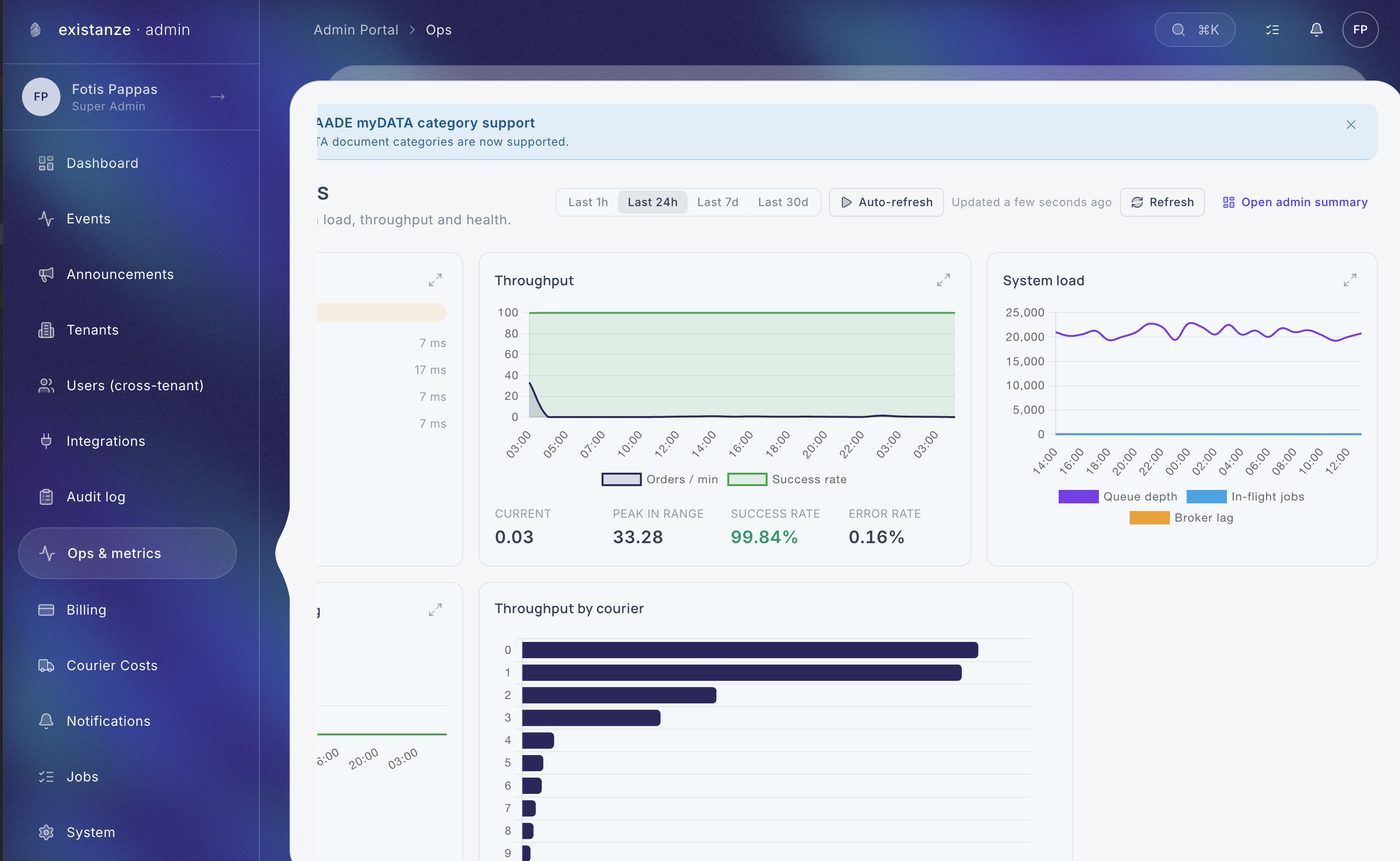
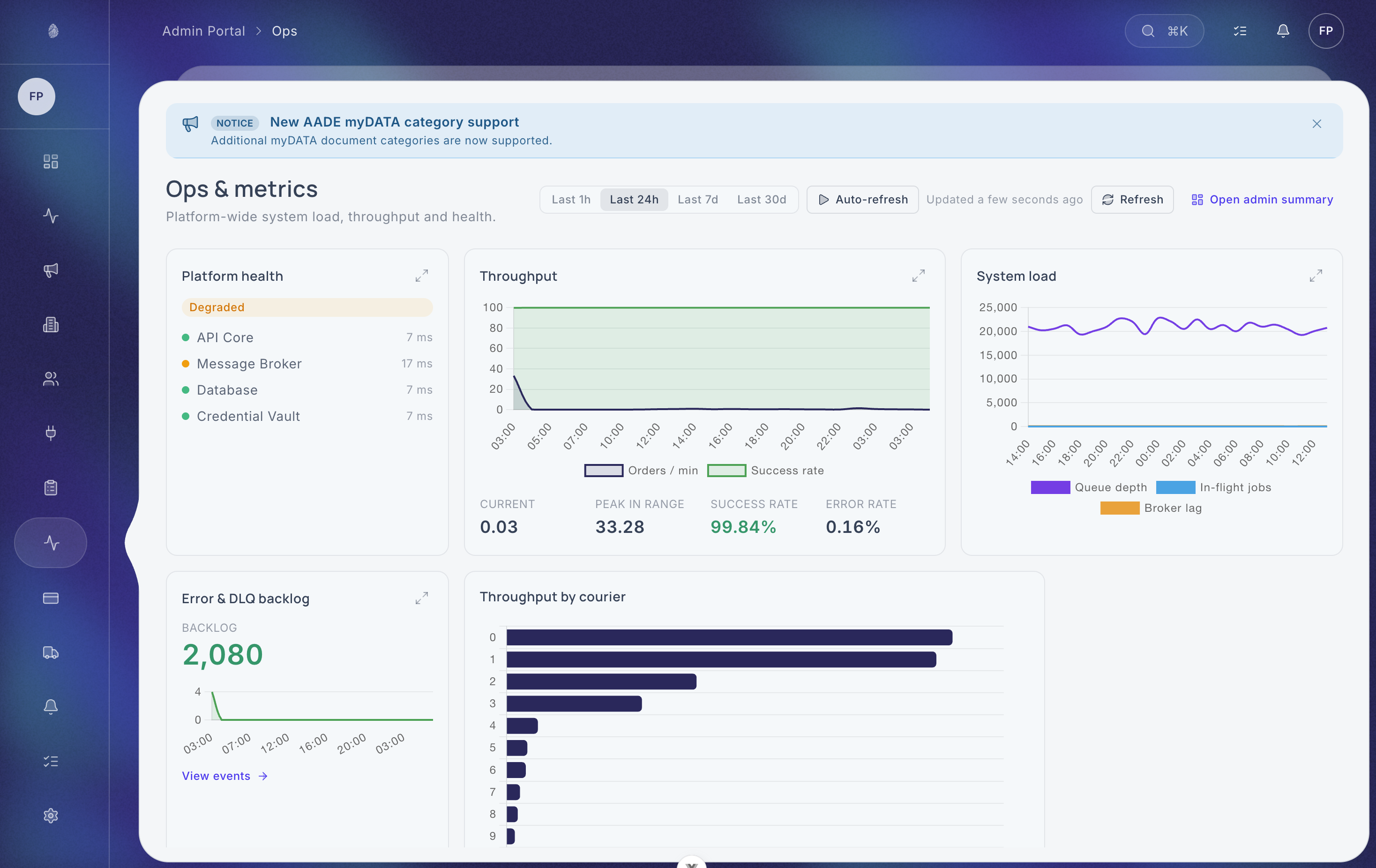
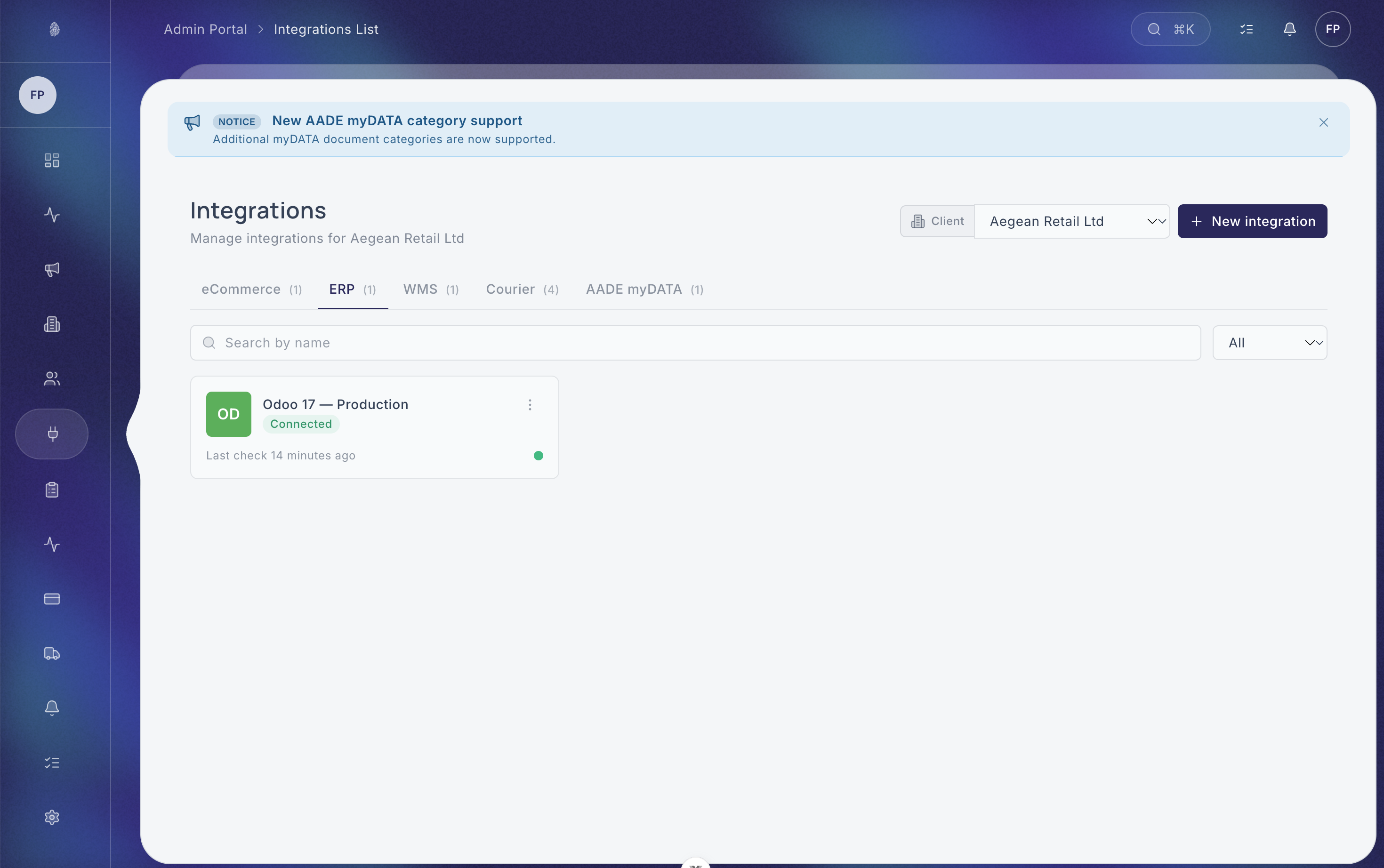
The customer portal: dashboard, live data-flow inspector and connector configuration.