Cross-Tool Automation
Event-driven orchestration spanning departments. A single business event triggers the right chain of actions automatically, with no scheduled exports, no manual handoffs and no scripts that break every quarter.
The need
A single business event should trigger a chain of actions across many tools, but today that chain is held together by ad-hoc scripts, scheduled exports and human follow-up.
You can usually identify the chain because somebody owns it as a part-time job. They run an export on Monday, paste it into a spreadsheet, and email a colleague who updates a system. Three days later the loop closes by hand. That is not a workflow; it is a workflow held together by people.
Where it shows up
- A new B2B customer in the CRM provisions an eCommerce account, an ERP customer record and finance credit terms, then notifies the sales rep, automatically.
- A successful payment triggers fulfilment, accounting recognition, customer communication and a marketing-attribution event.
- An employee onboarding provisions accounts in finance, HR, the project tool and the file-share.
- A courier return updates the WMS, refunds through finance, restocks the catalog and emails the customer.
What EXN does
Routes describe the chain of actions: receive an event, validate, transform, decide where to send it, send it, persist the outcome, retry on failure. Routes are configurable per tenant, so every organization encodes its own logic, and routes can call any connector in the library.
The same route engine that handles a sales-to-fulfillment chain handles an HR onboarding chain or a returns chain. The chains differ; the engine is the same.
add PNG → screenshots/p5-routes/
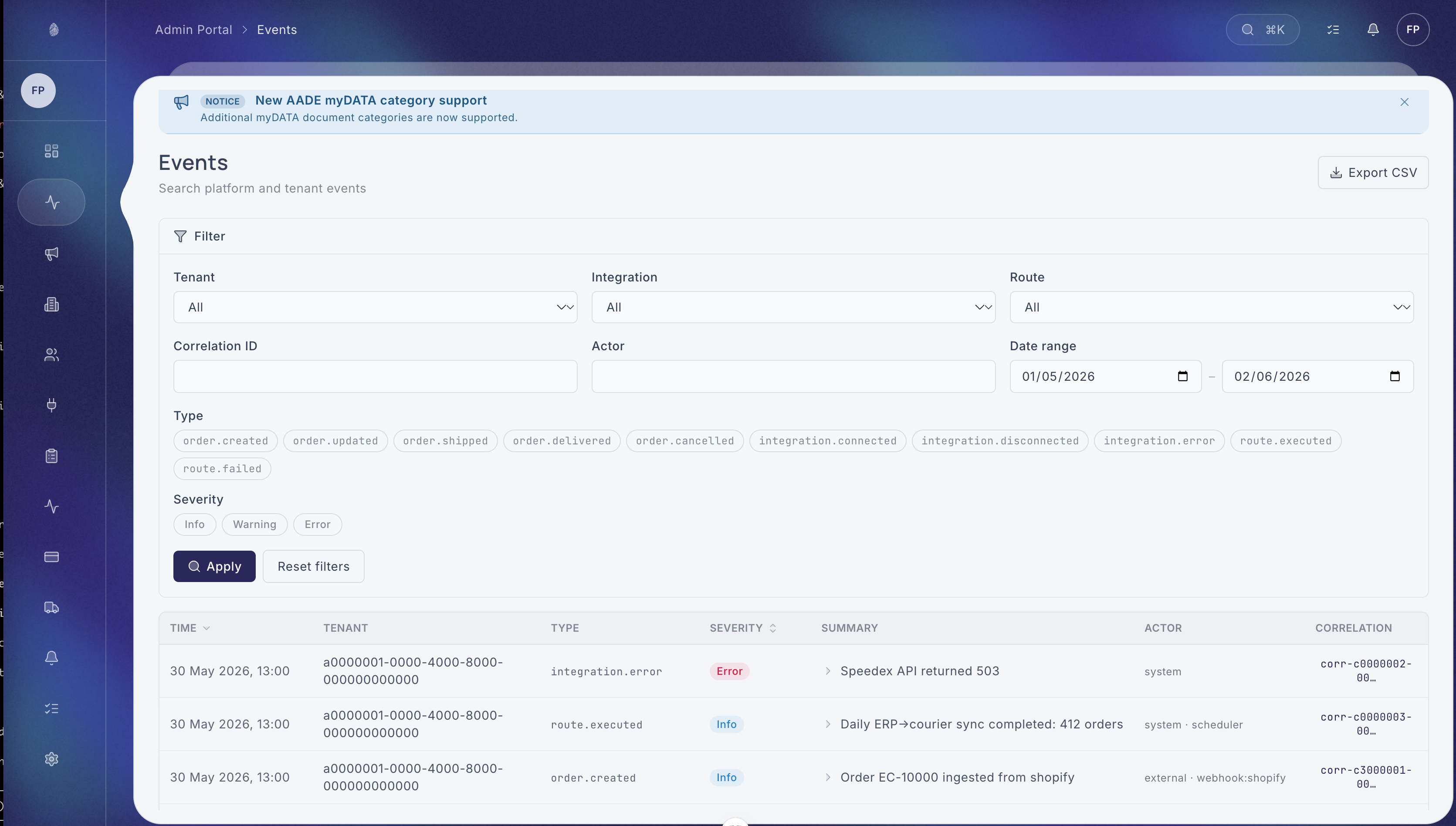
A route: the chain of steps a single event triggers across tools.
Where AI earns its place
01 · Service
AI-assisted route design
From sample event payloads, the AI proposes the chain of steps and engineers refine it.
02 · Service
Natural-language summaries
When a multi-step flow goes wrong, a single failed link is explained in one sentence rather than five log files.
01
No manual handoffs
Manual handoffs eliminated.
02
Seconds, not days
Cross-team workflows run in seconds rather than days.
03
No 3 a.m. pages
Errors are caught and recovered without ops getting paged at 3 a.m.